York, PA & York County resource
Radon Mitigation in York, PA
A plain-English guide for York and York County homeowners covering what radon mitigation is, when it's needed, typical Pennsylvania costs, and how to hire a PA DEP-certified professional.
Independent local resource. Not a substitute for a certified mitigator or a lab test.
EPA action level
4.0 pCi/L
PA certification
Required for radon businesses
Test first
Then mitigate if needed
Built for
York, PA & York County
Why this page exists
Straight answers, not a sales pitch
If you searched for radon mitigation in York, PA, you probably want straight answers, not a sales pitch. This page is built to be one complete local resource: what mitigation actually involves, what it tends to cost in Pennsylvania, how testing works, and how to hire someone who is actually certified to do the job.
Radon varies house to house, even on the same street. Your neighbor's test result does not predict yours, and a low reading in one part of the county does not mean every York County home is fine. The only way to know your number is to test your own home.
Pennsylvania is widely recognized as a state where elevated indoor radon shows up often enough that testing is a normal, sensible step for homeowners, not an overreaction. This page stays factual about that. The goal is to help you understand your options and make a good decision, not to scare you into one.
The basics
What is radon mitigation?
Radon mitigation is the process of reducing the level of radon gas inside a home. Radon is a naturally occurring gas that can seep in from the soil beneath a house, and in York County homes it typically enters through the foundation, cracks in the slab, sump pits, or crawlspaces. Mitigation systems work by intercepting that gas below the home and venting it outside before it ever reaches the air you breathe.
Mitigation is not the same thing as testing. Testing measures how much radon is currently in your home. Mitigation is the fix that lowers that number once you know it's elevated. You always test first, and mitigation only comes into play if the result calls for it.
If you're reading this because you got a high radon reading during a home sale, a refinance, or a DIY test kit you picked up yourself, you're in the right place. The next sections walk through what typically happens next, what it tends to cost in York, PA, and how to find someone qualified to do the work correctly.
Local context
Radon and homes in York, PA / York County
Pennsylvania is widely recognized as a state where elevated indoor radon shows up in homes at meaningfully higher rates than the national average. That does not mean every house has a problem, it means testing is the only way to know where your specific home stands.
Radon levels differ from one property to the next, even within the same neighborhood. Foundation type, soil conditions directly under the home, and how much of the living space sits below or at ground level all play a role. A finished basement or a home built directly on a slab has more ground contact than a raised structure, which is one reason those areas often get closer attention during testing.
This guide is written for homeowners in York, PA and the surrounding York County area, including nearby communities like West York. That is context, not a promise of service across every town in the county. If you live in the region and want a straight answer about your own home, testing is the starting point, not a guess based on your zip code.
Testing vs mitigation (decision order)
Radon decisions follow a logical order. Skipping a step either wastes money or leaves you guessing. Here is the sequence that actually makes sense.
- 1
Test your home.
Use a short-term test kit, a continuous radon monitor, or a professional test. If you're in the middle of a real estate transaction, a professional test is usually the standard buyers and lenders expect.
- 2
Compare your result to the EPA action level of 4.0 pCi/L.
If your result is at or above that number, mitigation is worth pursuing. Many homeowners choose to act even in the 2 to 4 pCi/L range, since lower is generally better and the cost of mitigation is often modest relative to long-term exposure.
- 3
Hire a PA DEP-certified mitigator.
They design and install a system suited to your home's foundation and layout. This is not a generic handyman job, it requires someone trained in how radon actually moves through a structure.
- 4
Retest after installation.
A proper mitigation job includes confirming the system actually brought your number down. If a contractor does not offer or recommend post-installation retesting, that is worth asking about directly.
Pennsylvania regulates who can legally perform radon testing and mitigation work for hire. Before you sign anything, verify that the person or company you're considering is actually certified. Two resources worth checking are the PA DEP Radon Division and the Radon Services Directory, both of which exist specifically to help homeowners confirm who is qualified to do this work in the state.
The mechanics
How radon mitigation works
Most radon mitigation systems follow the same basic principle: intercept the gas below the home and vent it outside before it has a chance to build up indoors. The exact setup depends on your foundation, but the mechanics are straightforward once you understand the pieces.
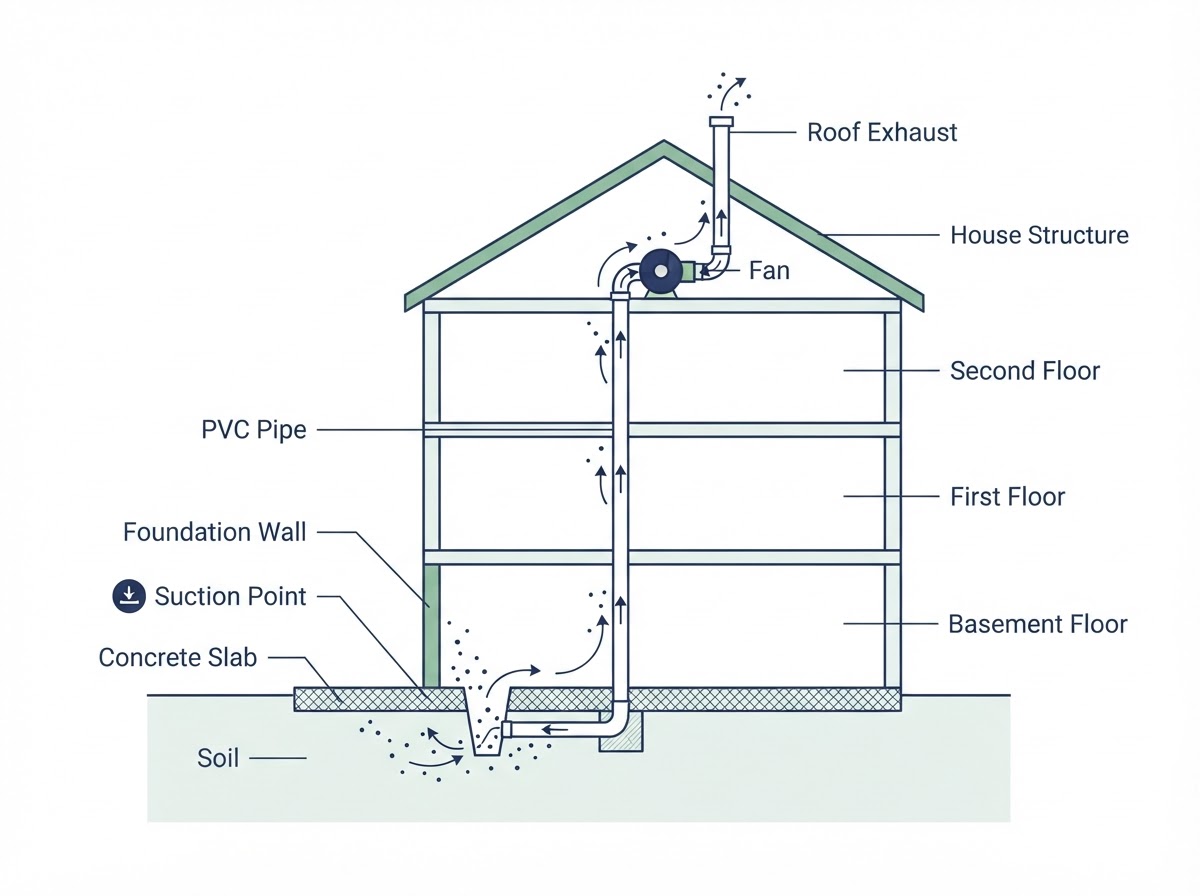
Sub-slab depressurization (most common)
This is the standard approach for homes with a concrete slab or basement floor, and it's what most York County homes end up with.
- A hole is cut into the slab, and a sealed suction point is installed beneath it
- PVC piping runs from that point up through the home, typically routed through a closet, garage, or exterior wall
- An inline fan creates continuous negative pressure, pulling soil gas from under the slab into the pipe
- The pipe exhausts above the roofline, away from windows and other openings, so the vented gas disperses safely outdoors
Homes with more than one foundation section, or a larger footprint, sometimes need more than one suction point to pull air evenly from under the entire slab.
Crawlspace approaches
If part or all of the home sits over a crawlspace instead of a slab, the system usually pairs a heavy-duty vapor membrane laid across the crawlspace floor with a suction point that draws air from beneath that membrane. The same fan-and-exhaust logic applies, it's just adapted to a dirt or gravel floor instead of concrete.
Sealing openings
Sealing visible cracks, gaps around pipes, and sump pit covers is a reasonable support step, and a good contractor will usually do some of it as part of the job. On its own, though, sealing is not a mitigation system. It does not create the negative pressure needed to actually pull radon out from under the home, so it should never be sold to you as a standalone fix.
What success looks like
A properly installed system has a few clear signs: the fan runs continuously and quietly, the system is labeled so anyone in the home knows what it is, and a post-installation retest shows a meaningfully lower number than what you started with. If any of those three things are missing, the job isn't finished.
Money
Radon mitigation cost in York, PA
How much does radon mitigation cost in York, PA?
Cost depends on a handful of specific things about your house, not a flat number that applies to everyone. Foundation type, how high your radon level tested, the layout of your basement or crawlspace, and how complex the system needs to be all move the price up or down. Two homes on the same street can end up with different quotes for legitimate reasons.
The figures below are observed market ranges pulled from publicly available cost information in the York, PA and Pennsylvania market. They are not a quote for your home, and no contractor should give you a firm number without seeing your foundation first.
Typical residential range
$800 – $2,200
Depending on the home
Common published average
$900 – $1,600
Per local and operator-published materials
Complex homes, meaning multiple suction points, difficult crawlspaces, or large footprints, can run higher than either range above.
Factors that move the price the most:
- Basement vs crawlspace vs slab foundation
- Whether the home already has a sump pit that can be adapted
- Interior pipe routing vs running the pipe on the exterior of the house
- Aesthetic routing choices, like hiding pipe inside a closet or wall chase
- Electrical work needed to power the fan
- The cost of a post-installation retest to confirm the system worked
Get a written scope of work from a PA DEP-certified contractor before you agree to anything. The cheapest bid on paper is not always the correct design for your foundation, and a low number sometimes means a single suction point where your home actually needs two.
Insurance and real estate
Standard homeowners insurance policies usually do not cover radon mitigation. Radon is generally treated as an environmental condition rather than sudden damage, so confirm the specifics with your own carrier rather than assuming either way.
Radon comes up often in Pennsylvania home sales. Buyers frequently test during the inspection period, and if the result comes back elevated, mitigation is sometimes negotiated as a condition of the sale, either as a credit or as work completed before closing.
Start here
Radon testing in York, PA
Testing is the step before any decision about mitigation gets made, and there are a few practical ways to do it.
DIY short-term test kits.
These sit in your home for a few days and are sent to a lab for results. They're inexpensive and a reasonable first step if you have never tested before.
Digital continuous monitors.
These give ongoing readings rather than a single snapshot, which is useful if you want to see how levels shift with seasons or HVAC use.
Professional testing services.
A certified tester places and retrieves the equipment and provides documented results. This is typically what real estate transactions require, since lenders and buyers usually want a result they can trust wasn't handled by an interested party.
Pennsylvania has, at various points, supported free or reduced-cost test kit programs through state or county channels. Availability changes, so check current PA DEP or your local county health department offerings directly rather than assuming a program is active right now. This site does not distribute test kits.
Typical test cost varies by method, with DIY kits at the low end and professional testing running higher due to the labor and documentation involved.
One myth worth clearing up directly: air purifiers do not fix radon. Radon is a gas that enters from the ground beneath your home, and no air filtration device addresses that source. The only real fix is a mitigation system that vents the gas before it gets inside.
Who should you hire?
How to hire radon mitigation help in York County
Pennsylvania regulates radon testing and mitigation businesses. This is not a courtesy license, it is a real requirement, so the certification step is not optional if you want the work done correctly and legally.
Here is the order to work through before you hire anyone.
- 1
Search the PA DEP Radon Services Directory.
This is the state's list of certified testers and mitigators. Start here, not with a general contractor search or a name a neighbor mentioned in passing.
- 2
Confirm certification status.
A company can advertise radon services without being certified for mitigation specifically. Ask directly and verify the name against the state directory before you schedule anything.
- 3
Ask about system type, fan warranty, post-mitigation testing, and a written estimate.
A certified mitigator should be able to explain why they are recommending a specific system design for your foundation, not just quote a flat price over the phone.
- 4
Avoid pressure tactics and uncertified operators.
A legitimate mitigator does not need to close you on the spot. If someone is pushing same-day signing or refuses to put a scope in writing, that is a reason to walk, not a reason to hurry.
Checklist before you sign:
- Confirmed the contractor's name matches an active certification in the PA DEP directory
- Received a written scope of work describing the exact system, not a verbal estimate
- Asked what warranty covers the fan and how long it lasts
- Confirmed post-installation retesting is included, not billed separately later
- Have a clear total price in writing, with no vague final cost may vary language
If you would like help thinking through your specific situation, use the contact option on this page to ask a question. We can point you toward how to search the certified provider directory and what to ask once you have a few names. Reach out at hello@radonmitigationnearyorkpa.com if you prefer email over a form.
What this site is / is not
This website is an informational guide about radon mitigation for homeowners researching York, PA and York County. It exists to answer common questions in plain language, not to replace the professionals who actually test and fix radon problems.
It is not a substitute for professional testing, certified mitigation work, medical advice, or legal advice. If you need any of those, work directly with a licensed professional or the appropriate agency.
Always verify contractor certification with PA DEP before hiring anyone for testing or mitigation. Certification status can change, and the state directory is the only reliable source, not a company's own website or a review site.
The cost figures on this page are general market ranges pulled from publicly available information, not a bid for your home. Your actual price will depend on a certified contractor evaluating your specific foundation and radon level.
Questions
FAQ
How much does radon mitigation cost in Pennsylvania?
Statewide, most homeowners see mitigation costs land somewhere in the roughly $800 to $2,200 range, with the exact number depending on foundation type, radon level, and how complex the install is. Some published averages for the region sit closer to $900 to $1,600. A certified contractor can give you a real number after seeing your home, not a phone quote.
How much does a radon mitigation system cost in York, PA / York County?
York County pricing tends to follow the same general range as the rest of Pennsylvania, roughly $800 to $2,200 for a standard system. Homes with basements, simple layouts, and easy exterior pipe runs usually land on the lower end. Multiple suction points or tricky crawlspaces push the price up. Get a written scope before you commit.
Will insurance pay for radon mitigation?
Usually, no. Standard homeowners insurance policies typically treat radon mitigation as a maintenance or improvement cost, not a covered repair, since radon is a naturally occurring condition rather than sudden damage. Some real estate transactions handle it differently, with mitigation negotiated between buyer and seller. Confirm your specific policy with your carrier before assuming either way.
What time of year is worse for radon?
Radon levels tend to run higher in colder months, generally fall through winter, because homes are sealed up tighter and heating systems can pull more soil gas indoors. That does not mean summer levels are safe to ignore. A short-term test in winter often shows a higher reading than the same home tested in summer, which is why professionals recommend understanding seasonal variation before drawing conclusions from one test.
What is the average radon level in a home in Pennsylvania?
Pennsylvania is widely recognized as a state where indoor radon runs higher than the national average, but there is no single average that applies to your specific house. Levels vary significantly from one home to the next, even on the same street, based on soil conditions and foundation type. Testing your own home is the only way to know where you actually stand.
Does PA offer free radon test kits?
Pennsylvania and some county health departments have offered free or low-cost radon test kit programs at various points, but availability changes over time. Check current offerings directly through PA DEP or your county health office rather than assuming a program is active. If nothing is available, low-cost test kits are widely sold at hardware stores and online.
How much does a radon test cost in PA?
Short-term DIY test kits typically run in the range of $15 to $30 at most hardware stores. Professional testing, especially for real estate transactions where a certified tester is required, usually costs more, often in the $100 to $200 range depending on the provider and test type. Continuous digital monitors sit somewhere in between as a one-time purchase.
Do air purifiers get rid of radon?
No. Air purifiers, including HEPA filters, are not built to address radon gas and will not bring your levels down to a safe range. Radon requires an actual mitigation system, typically sub-slab depressurization, that vents the gas from below the home before it enters living space. Do not substitute an air purifier for a real fix if your test came back elevated.
What kills radon gas?
Nothing kills radon since it is a naturally occurring radioactive gas, not a contaminant that can be neutralized chemically. The only proven approach is removing it from the home through proper ventilation, most commonly a sub-slab depressurization system that draws soil gas out through a pipe and fan before it seeps indoors. Sealing alone is a support measure, not a solution.
What homes are more likely to have radon?
Any home can have elevated radon regardless of age, style, or whether it has a basement, crawlspace, or slab foundation. Homes built over certain soil and rock types tend to see higher readings, and Pennsylvania as a whole sits in an area where this is more common. The only reliable way to know your risk is to test your specific house.
What is the fastest way to reduce radon in a house?
A properly designed and installed sub-slab depressurization system is the fastest legitimate way to bring radon levels down, often reducing them significantly within a day or two of installation. There is no quick fix, gadget, or purifier that replaces this. If your test came back high, the real timeline runs through testing, hiring a certified mitigator, and retesting after install.
Do I need mitigation if my result is above 4.0 pCi/L?
The EPA sets 4.0 pCi/L as its action level, meaning mitigation is recommended at or above that number. Many homeowners and some professionals also consider action between 2 and 4 pCi/L, since no level of radon exposure is considered completely risk-free. A PA DEP-certified mitigator can help you weigh your specific result and decide what makes sense for your home.
Next steps for York, PA homeowners
- 1
Test if you have not already. A short-term kit or a professional test is the starting point, not a guess based on your neighbor's result.
- 2
Confirm your result. Know your actual number before deciding on next steps.
- 3
If elevated, contact PA DEP-certified mitigators. Use the state directory, not a general contractor search.
- 4
Retest after work is completed. A finished install should come with a follow-up test that confirms the fix actually worked.
Ask a question